
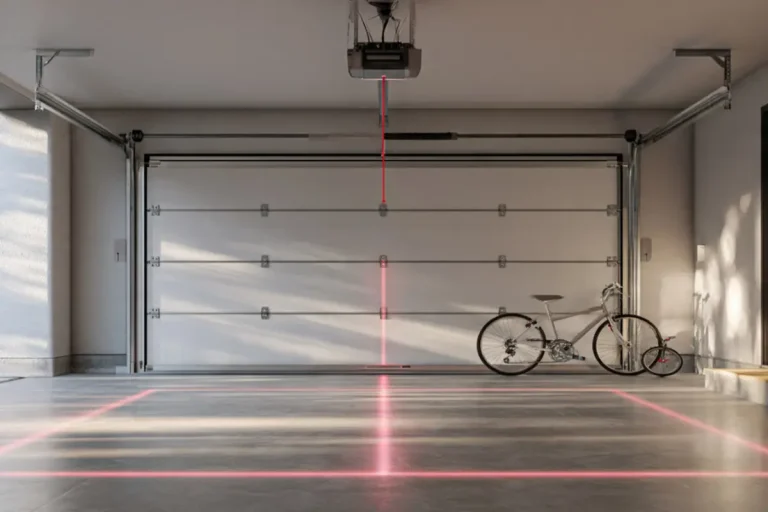
Modern garage door safety features, including photoelectric sensors, auto reverse mechanisms, force detection systems, and manual release functions, work together to prevent injuries, protect property, and ensure safe operation every time your door moves. These built in protections are not optional extras. They are engineering standards that have been saving lives since the early 1990s, and every homeowner should understand how they work.
Why Garage Door Safety Features Actually Matter
Your garage door is the largest moving object in your home. Most residential overhead doors weigh somewhere between 150 and 500 pounds depending on the material, size, and insulation. When that kind of mass is in motion, the consequences of a malfunction can be severe. Children, pets, and adults have all been injured by doors that closed without warning or failed to stop in time.
That is exactly why the U.S. Consumer Product Safety Commission stepped in and mandated automatic reversal systems and photoelectric sensor technology for all automatic garage doors manufactured from 1991 onward. If your door was installed or replaced in the last three decades, it should have these protections in place. The question is whether they are still functioning correctly, and whether you know what to look for when they are not.
The Photoelectric Sensor: Your Door’s First Line of Defense
Walk into almost any garage in Wichita and look toward the bottom of the door frame on both sides. You will see two small sensor units mounted roughly four to six inches above the ground. These are your photoelectric sensors, also called photo eyes or safety eyes, and they are doing an important job around the clock.
One sensor sends an invisible infrared beam straight across the door opening. The other sensor on the opposite side receives it. As long as that beam travels uninterrupted from one side to the other, the opener reads the path as clear and allows the door to close normally.
The moment something breaks that beam, whether it is a person walking through, a bicycle left in the way, or a pet running under the closing door, the sensors immediately signal the garage door opener to stop and reverse direction. This happens in a fraction of a second. The door does not hesitate, negotiate, or ask for confirmation. It reverses.
What makes this system so reliable is its simplicity. There are no moving parts to wear out in the sensor itself. The main vulnerabilities are physical misalignment, dirty lenses, and damaged wiring, all of which are straightforward to identify and fix. If your garage door sensor repair needs attention in Wichita, these are the first three things a technician will check.
Common Signs Your Photoelectric Sensors Are Failing
A well-functioning sensor pair operates silently in the background. You only notice them when something goes wrong. Watch for these signals:
The door begins closing and immediately reverses for no visible reason. This almost always points to a misaligned or obstructed sensor. The sending unit on one side may have shifted just enough that the beam is no longer reaching the receiver cleanly.
One of the sensor indicator lights is flashing or off entirely. Most sensor systems use LED lights to communicate status. A steady green on the receiver and a steady amber on the sender usually means everything is aligned and working. A blinking light typically indicates a blocked or misaligned beam.
The door refuses to close at all, even with nothing in the way. If the sensors cannot confirm a clear beam path, many openers will simply refuse to close the door as a precaution.
Dirt, spider webs, or moisture on the sensor lenses can interfere with beam transmission just enough to cause intermittent false triggers. A clean dry cloth wiped across each lens is the first thing to try before assuming a more serious problem.
Read Also: How to Lubricate Garage Door Parts the Right Way
The Auto Reverse Mechanism: Backup Protection When the Beam Misses Something
Photoelectric sensors are excellent at detecting upright obstructions that interrupt the beam. But what about something flat on the ground, like a coiled garden hose, a low toy, or loose material that is below the beam height? That is where the mechanical auto-reverse system takes over.
The auto-reverse mechanism has been standard on all garage door openers manufactured since 1991. It works differently from the photoelectric sensor because it relies on physical contact and pressure rather than a beam. When the bottom edge of the closing door makes contact with an object on the ground, the motor registers the unexpected resistance and immediately reverses direction. The door stops and opens back up within two seconds of that contact.
This system is governed by the opener’s force settings, a calibration that determines how much resistance triggers a reversal. If the force sensitivity is set too high, meaning the door keeps closing even under significant resistance, it becomes a safety hazard. If it is set too low, the door may reverse on its own without any obstruction, making it frustrating to operate.
Testing this feature at home is simple. Place a two-by-four board or a similar solid object flat on the ground directly under the center of the door. Press the close button. When the door’s bottom seal makes contact with the board, it should stop and reverse upward within two seconds. If it presses down and continues without reversing, the force sensitivity needs to be recalibrated by a professional.
The Consumer Product Safety Commission recommends testing the auto-reverse feature at least once a month. It takes about thirty seconds and can be the difference between a close call and a real injury.
Force Detection Technology: The Intelligence Inside the Opener
Most modern garage door openers incorporate force sensors directly into the motor unit itself. These sensors continuously monitor the resistance the motor experiences while moving the door in either direction. Every overhead door has a specific force profile, meaning there is a predictable amount of resistance at each point in the travel path based on spring tension, roller friction, and door weight.
When the motor encounters resistance outside of that expected range, the force detection system interprets it as an obstruction or a mechanical problem and shuts the motor down. This layer of protection is particularly valuable because it can catch situations that both the photoelectric sensor and the physical auto-reverse might miss, such as a cable coming off the drum while the door is in motion.
Force sensors also protect the mechanical components themselves. If a torsion spring breaks or a roller seizes up, the sudden spike in resistance will typically trigger a force sensor shutdown before the opener motor burns itself out trying to compensate.
Brands like LiftMaster, Chamberlain, and Genie have each developed their own versions of this technology, but the underlying principle is the same across all major manufacturers. If your opener is more than fifteen years old, the force calibration may have drifted from its original setting due to wear in the springs and hardware. A periodic tune-up that includes force adjustment is one of the most valuable maintenance steps you can take.
Read Also: What Counts as a Garage Door Emergency? When to Call Right Away
The Manual Release: Essential Safety When Power Fails
Every automatic garage door opener is required to include a manual release mechanism, typically a red cord hanging from the trolley rail above the center of the door. Pulling this cord disconnects the door from the opener drive system and allows the door to be moved by hand.
This feature becomes critical in two main scenarios. The first is a power outage, which can leave you trapped inside or outside your garage if you do not know how to use the manual release. The second is an opener malfunction where the motor unit itself has failed and the door cannot be operated electrically.
There are a few things to keep in mind about manual operation. First, a properly balanced door should be relatively easy to lift by hand. If you disengage the opener and the door feels extremely heavy or falls quickly when you let go, that is a sign the torsion springs are either worn out or broken. A garage door should hold its position when lifted halfway up and released. If it drops, the spring balance needs professional attention before the opener is reconnected.
Second, never disconnect the manual release while the door is in the down position if you suspect the springs are broken. Without the springs carrying the door’s weight, the door may be too heavy to lift safely by hand.
Motion Detection and Smart Safety Features in Modern Openers
Garage door technology has advanced considerably beyond the basic sensor and reversal systems. Many newer openers from brands like LiftMaster and Chamberlain now include motion detection sensors inside the garage itself. These detect movement in the garage and can be configured to automatically trigger the opener’s light or prevent the door from closing if someone is detected in the path.
Smart garage door systems that connect to Wi-Fi have introduced another layer of safety: real-time alerts and remote monitoring. If your door is opened or left open for longer than a set period, you receive a notification on your smartphone. Some systems allow you to view your garage interior through a camera and close the door remotely from anywhere with a signal. For anyone who has backed out of the driveway only to wonder whether they actually closed the garage, this feature alone is worth the upgrade.
Battery backup systems are another modern addition that addresses the power outage problem more elegantly than simply relying on the manual release. With a backup battery integrated into the opener, your door continues to operate normally during outages. This is particularly valuable in Wichita, where severe spring weather and ice storms can knock out power for extended periods.
The Bottom Seal and Safety Edge: Ground Level Protection
While sensors and reversal mechanisms get most of the attention, the bottom seal on your garage door serves its own protective function. A quality bottom seal creates a tight contact point between the door and the ground that helps trigger the auto-reverse mechanism consistently. When the seal is cracked, brittle, or missing entirely, the door may contact the ground unevenly and reduce the reliability of the pressure-based reversal system.
Higher-end commercial and specialty residential doors sometimes incorporate a safety edge strip embedded in or attached to the bottom of the door. These pressure-sensitive strips are wired directly into the opener and trigger an immediate reversal when compressed. They provide more precise and consistent detection than relying solely on motor force measurement.
If your door has weathered multiple Wichita winters and you notice the bottom seal cracking or pulling away from the door, replacing it is a straightforward maintenance task that protects both the safety system and your energy efficiency.
Read Also: Garage Door Off Track: Causes, Risks, and What to Do Next
How to Test Your Garage Door Safety Features at Home
You do not need any tools or technical knowledge to run a basic safety check on your door. Here is a simple monthly routine:
Start with the photoelectric sensor test. With the door in the open position, start closing it using the wall button or remote. While it is in motion, wave your hand through the beam path near the sensors. The door should immediately stop and reverse. If it does not, the sensors need to be inspected.
Next, test the auto-reverse with a physical object. Lay a two-by-four flat on the ground under the center of the door. Close the door. When the bottom seal contacts the board, the door must stop and reverse within two seconds. Anything slower or any failure to reverse means the force sensitivity requires professional adjustment.
Finally, test the manual release. Pull the red cord with the door in the closed position and try lifting the door by hand. It should move smoothly upward and hold its position when you stop at the halfway point. If it does not, there is a spring balance issue worth having a technician evaluate.
If your garage door opener repair needs are more significant than a simple calibration, a certified technician can diagnose and correct force settings, sensor alignment, and reversal sensitivity in a single visit.
When to Call a Professional About Garage Door Safety Systems
Some safety issues can be checked or cleaned at home, but others require a licensed technician. Call a professional when:
The door reverses on its own repeatedly even after you clean the sensors and confirm alignment. This could indicate a wiring issue between the sensors and the opener control board.
The auto-reverse test fails even after you manually adjust the force settings on the opener unit. Force calibration involves understanding the spring tension and door weight together, and getting it wrong can make the door more dangerous, not less.
Any component of the opener or sensor system was physically damaged by a vehicle strike, flooding, or pest intrusion. Damaged wiring inside sensor housings can cause intermittent failures that are easy to miss until they become dangerous.
The door is more than ten years old and has never had a professional safety inspection. Springs, cables, and opener components all have finite service lives, and a safety audit catches problems before they become emergencies.
At Wichita Garage Door Experts, our technicians inspect the full safety system as part of every repair call, not just the part that brought us out. Whether you need a garage door spring repair or a complete safety system evaluation, we bring the experience to do it right the first time.
Your garage door’s safety features are not background noise. They are active protection systems that, when working correctly, prevent serious injuries every day. Photoelectric sensors, auto-reverse mechanisms, force detection, manual releases, and smart monitoring all work together as layers of defense against a door that weighs as much as a small vehicle.
The good news is that testing these systems takes less than five minutes and requires nothing more than a board on the floor and a waving hand. Do it monthly. Call a professional when the tests fail. And if your door is aging, remember that preventive maintenance costs a fraction of what emergency repairs or, far worse, an injury would.
Wichita homeowners can reach Wichita Garage Door Experts any time by calling us. We offer same day service, free estimates, and complete garage door safety inspections across Wichita and surrounding communities in Sedgwick County.
